Articles
GHK-Cu Copper Peptide: The best Science-Backed Ingredient Reshaping Anti-Aging and Repair 2026
Apr
visit our catalog PrimegalaxyStore
GHK-Cu Copper Peptide In the ever-evolving world of skincare and regenerative medicine, few ingredients have stood the test of rigorous scientific scrutiny quite like GHK-Cu. Often labeled as “copper peptides” on luxury serums and clinical-grade creams, this single molecule has garnered attention not just for reducing wrinkles, but for fundamentally altering how human tissue repairs itself.
But does it live up to the hype? As a naturally occurring peptide complex, GHK-Cu offers a unique mechanism that synthetic chemicals often fail to replicate. Here is the evidence-based breakdown of what GHK-Cu is, how it works, and why it might be the most versatile bioactive ingredient available today.
What is GHK-Cu Copper Peptide? (The “Youth Molecule”)
GHK-Cu stands for Glycyl-L-Histidyl-L-Lysine complexed with Copper (II) . It is a small, naturally occurring tripeptide (a chain of three amino acids) with a high affinity for binding copper ions. This complex was first discovered in human plasma by Dr. Loren Pickart in 1973 .
Think of it as a messenger and a carrier. As we age, the levels of GHK in our body plummet. In our 20s, levels are high, supporting robust repair. By the time we reach 60, natural GHK levels drop by roughly 60% . This decline correlates directly with the skin’s decreasing ability to heal and regenerate.
How Does It Work? Unpacking the Mechanism
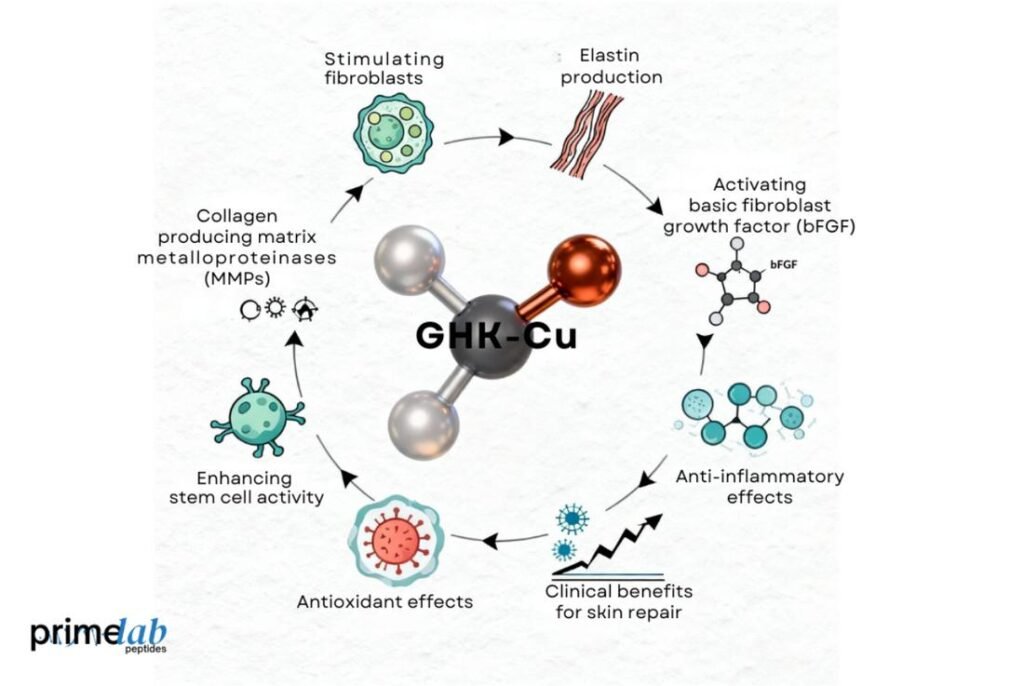
Unlike harsh exfoliants that strip the skin or retinoids that accelerate turnover through irritation, GHK-Cu works via gene modulation. It penetrates the stratum corneum (the skin’s top layer) and communicates directly with fibroblasts—the cells responsible for producing structural proteins.
Research indicates that GHK-Cu can influence the expression of thousands of genes, essentially resetting them to a healthier, younger state . It upregulates genes involved in antioxidant defense and tissue repair while downregulating those responsible for inflammation.
Furthermore, the copper ion is not just a passenger; it is essential for the activity of lysyl oxidase, an enzyme required for cross-linking collagen and elastin, which gives skin its structural integrity and bounce .
The Key Benefits of GHK-CuGHK-Cu
1. Deep Skin Rejuvenation & Anti-Aging
The most celebrated use of GHK-Cu is in reversing photodamage and chronological aging. Clinical studies have demonstrated that GHK-Cu is not just an equal to traditional anti-aging agents; in some metrics, it is superior.
- Collagen Production: One comparative study found that GHK-Cu increased collagen deposition in 70% of participants, compared to 50% for Vitamin C and 40% for Retinoic acid .
- Skin Tightening: A 12-week study showed that a GHK-Cu cream significantly improved skin density, thickness, and firmness, leading to a reduction in fine lines and deep wrinkles .
2. Accelerated Wound Healing
GHK-Cu was originally discovered for its healing properties. It promotes angiogenesis (the formation of new blood vessels) and increases the synthesis of proteoglycans and glycosaminoglycans .
- Clinical Application: Recent clinical trials are exploring topical GHK-Cu gels for acute wound healing, measuring the speed of re-epithelialization in standardized wounds . The results continue to support its use in post-procedure recovery and chronic wound management.
3. Hair Growth Stimulation
For those experiencing thinning hair, GHK-Cu offers a topical solution. It works by enlarging hair follicle size and prolonging the anagen (growth) phase of the hair cycle.
- Efficacy: Studies comparing GHK-Cu to 5% Minoxidil found the copper peptide complex to be similarly effective in stimulating hair growth, without the irritation often associated with traditional hair loss drugs .
4. Antioxidant and Anti-Inflammatory Protection
Copper peptides act as potent antioxidants. They scavenge harmful lipid peroxidation products and reduce the production of inflammatory cytokines like TNF-β and IL-6 . This makes it excellent for calming sensitive, reactive skin while repairing the barrier.
glow peptide benefits vs. GHK-Cu Injectable: Choosing Your Method
There is a significant distinction between buying a cream and using therapeutic injections.
- Topical (Creams/Serums): This is the safest and most accessible method for general anti-aging and hair maintenance. Look for concentrations between 1% to 3% . Modern delivery systems, such as liposomal encapsulation or specialized cyclodextrin technologies, are now being used to help this tripeptide penetrate deeper into the dermis rather than just sitting on the surface .
- Injections (Subcutaneous): Used for systemic effects like widespread tissue repair, injectable GHK-Cu is typically dosed at 1-2mg per day in research settings . Crucial Note: Injectable peptides should only be administered under medical supervision. Self-administration carries risks of infection and copper dysregulation.
Are There Side Effects?
GHK-Cu is generally regarded as safe (GRAS) for topical use. However, there are nuances:
- The “Copper Uglies”: Anecdotally, some users report a temporary “purge” or slight skin sensitivity when starting high-potency copper peptides.
- Overuse: Using too many actives (e.g., mixing copper peptides with strong Vitamin C or acids) can sometimes neutralize the copper complex or cause irritation. It is often recommended to separate copper peptide application from low-pH actives .
- Rare Reactions: Topical use may cause mild redness or itching in extremely sensitive individuals. Injectable use carries risks of injection site pain, nausea, or headaches .
The Future of GHK-Cu Copper Peptide
The science is moving beyond cosmetics. Researchers are actively engineering recombinant GHK-Cu through advanced biomanufacturing to ensure purity and scalability . The future lies in “next-generation delivery”—solving the historical problem of peptide permeability to allow GHK-Cu Copper Peptide to reach the deep dermis where it is needed most .
Whether you are looking to restore skin vitality, accelerate healing, or stimulate hair growth,GHK-Cu Copper Peptide stands as a pillar of evidence-based regenerative aesthetics. It is not a fad; it is a return to the biology of youth.
Disclaimer: This article is for informational purposes only and does not constitute medical advice. Always consult with a qualified healthcare professional before starting any new treatment regimen, especially regarding injectable peptides.
Frequently Asked Questions (FAQ)
Q: Can I use GHK-Cu Copper Peptide with Retinol (Vitamin A)?
A: While possible, it is often recommended to use copper peptides in the morning and retinol at night. Copper is a heavy metal that can oxidize Vitamin C, but it generally pairs better with hydrating ingredients (Hyaluronic acid, Niacinamide) than with harsh exfoliants or low-pH actives.
Q: How long does it take to see results?
A: For anti-aging, studies show measurable improvements in firmness and density as early as 4 weeks, with significant wrinkle reduction by 12 weeks . For hair growth, consistent use for 3-4 months is required .
Q: Is GHK-Cu the same as “Copper Tripeptide-1”?
A: Yes. These terms are used interchangeably in cosmetic ingredient labeling
